

Here’s a revolutionary idea: let’s treat a blemish without leaving behind a crusty, red, flaky mess that takes longer to heal than the pimple itself.
Unfortunately, most spot treatments I tried did exactly that. Drying formulas—often alcohol- or clay-based—aim to “dry out” the blemish. But the result? An inflamed asteroid that’s harder to cover with concealer than the original zit.
Why the Conventional Acne Approach Doesn’t Make Sense
Many dermatologists treat acne like they’re cleaning up an oil spill—but they forget to address the actual oil leak down below the surface.
Most conventional treatments—think benzoyl peroxide, salicylic acid, and even isotretinoin—work by aggressively drying the surface of the skin. But here's the twist: dry, irritated skin can actually trigger more oil production. The skin’s feedback loops interpret dryness as distress, signaling the sebaceous glands to go into overdrive.
And yes, bacteria play a role in acne—but so do hormones, inflammation, and the overall health of your skin barrier. A surface-only solution simply isn’t enough. For a deeper look at holistic, science-backed ways to manage breakouts, explore our full guide to natural acne solutions.
The Birth of Spotless
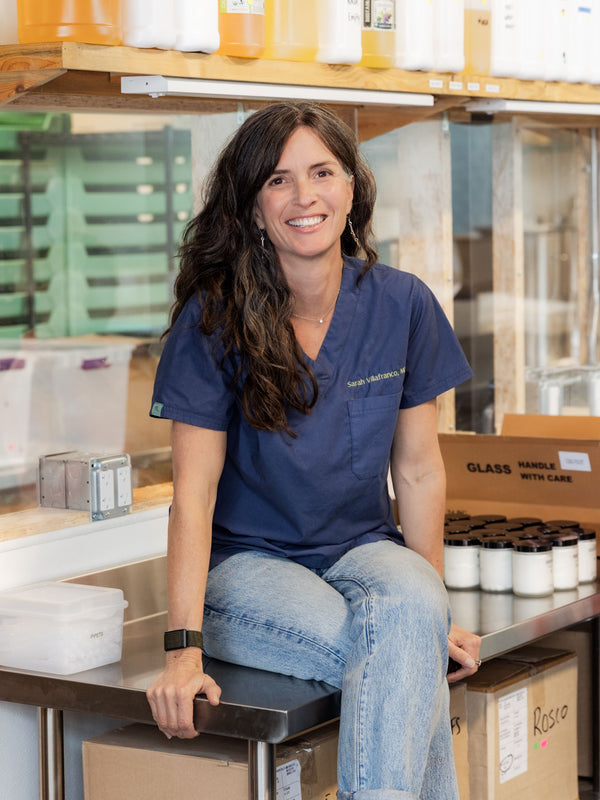
I formulated Spotless Blemish Oil after one particularly frustrating encounter with a cult-favorite pink spot treatment which shall remain unnamed. I followed the instructions to the letter and woke up to a bright red crater that looked—and felt—worse than the blemish I started with.
That was my breaking point. I sat down at the formulator’s bench and started crafting what I actually wanted in a blemish treatment:
✔️ Calming
✔️ Antibacterial
✔️ Non-drying
✔️ Nourishing to the surface of the skin
Key Ingredients (and Why They Matter)
Evening Primrose Oil
More than half the formula is made of this anti-inflammatory, barrier-supportive oil. It helps the skin maintain integrity at the surface—sending calming signals to sebaceous glands below that there’s no need to panic.
Essential Oils of Thyme, Cajeput, and Lavender
These essential oils pack serious antibacterial and anti-inflammatory power. They help reduce the actual cause of inflammation—without the burn.
Lemon and Parsley Essential Oils
Contribute a light, herbal scent and support the antimicrobial mission.
Cypress Essential Oil
Mildly astringent and supportive of circulation, it gives the formula just enough tightening effect—without overdrying.
The result? A blemish oil that works with your skin, not against it.
How to Use Spotless Blemish Oil
-
The moment you feel a blemish forming, start applying Spotless 3–4 times per day.
-
Most important: apply it as the last step in your evening routine.
-
Always apply it to clean skin, but as the last step, after your moisturizer or serum.
-
Use a clean cotton swab or pinky finger to dab it on—don’t roll it directly on your skin (that can release too much product).
-
Avoid your eyes. Please.
Spotless is super concentrated, so it’s not meant to be used all over your face—just as a targeted treatment.
How Long Does It Last?
-
For most people, one tiny bottle lasts 4–6 months with occasional use.
-
If you’re using it regularly or treating multiple blemishes at once, you’ll go through it a bit faster—expect about 2–4 months of use.
But Wait... Why Does It Smell So Good?
You’re not imagining it—Spotless smells amazing. The blend of lemon, parsley, lavender, and thyme gives it a light, herbal aroma that people constantly ask us to turn into a perfume.
We haven’t caved yet. But you’re not alone in wanting to smell like your blemish oil. Stranger things have happened in skincare.
Final Thoughts
Spotless Blemish Oil is the spot treatment I wish I’d had as a teenager, and am thrilled to have as a perimenopausal woman. It doesn’t sting. It doesn’t flake. It doesn’t leave your skin angry and confused. It just... works.
If you’re ready to rethink your approach to blemishes, Spotless is a powerful (but still gentle) place to start.

The information contained in this post is for educational interest only. This information is not intended to be used for diagnosis or treatment of any physical or mental illness, disease, or skin conditions.